Data Residency for AI: Where Your Assistant's Data Lives
2026-11-12

AI data residency is the location where an AI system stores and processes your data. That location can be a country, a region or specific hardware. The catch is that storage and processing are often two different places, and logs, backups and support access can follow their own paths. If you use an AI assistant for work, you need to know all of those paths, not just the region name on a settings page.
This guide covers what residency means for AI, how it differs from data sovereignty, what US readers need to know about rules and retention, and a checklist you can apply to any assistant, including a managed one like ours.
TL;DR
- Residency is about where data is physically stored and processed. Sovereignty is about which legal system can reach it. They can point to different countries.
- Choosing a region usually fixes where data sits at rest. It does not automatically fix where inference runs, or where logs, metadata and support data go.
- The US has no single federal AI data-residency law. Obligations come from sector rules, state privacy laws, contracts and procurement requirements.
- Retention matters as much as location. Ask what is kept, for how long, and how deletion works across backups and memory.
- A dedicated, encrypted server reduces the number of places your assistant's data can sit. Pair it with the checklist below.
Table of Contents
- What AI data residency actually covers
- Does a US region keep everything in the United States?
- Data residency vs. data sovereignty
- What US rules can affect where AI data goes
- Data retention: the other half of the question
- A checklist for judging any AI assistant
- Why a dedicated server simplifies the picture
- Our perspective
- Try a private OpenClaw server
- FAQ
- Sources
What AI data residency actually covers
In the pre-AI era, residency mostly meant one question: which data center holds my files? An AI assistant adds several more layers. Your prompt travels to a model. The model runs somewhere. The answer is logged. A memory store keeps context for next time. Files get indexed into embeddings for semantic search. Each layer can live in a different place.
A plain-language guide from the AI Literacy Foundation warns that a tool can store data in one region while processing it in another, and that logs, metadata, subprocessors and support access may follow separate geographic routes.
Vendor documentation shows the same split. Google Cloud's Vertex AI documentation says data stored at rest in the location you select stays there, and ML processing happens in the region or multi-region where the request is made. It also says that for regional endpoints not explicitly listed, there is no guarantee that processing occurs in a specific location. Google's Agent Assist documentation adds that its ML-processing location commitment is supported only in US and EU locations, and that requests to multi-region APIs may be processed in any region within that multi-region.
So "stored in the US" is a starting point. Whether it is a complete answer depends on what you store, which model you call, and what that provider promises for each data category.
The five places AI data can sit
- Prompts and outputs. The conversation itself, in transit and at rest.
- Inference. The hardware that runs the model on your request.
- Memory and files. Persistent context, uploaded documents and the embeddings built from them.
- Logs and metadata. Timestamps, usage statistics, account details, error traces.
- Backups and support copies. Snapshots, and anything an engineer can see while fixing a ticket.
When someone says an assistant "keeps data in the US," ask which of these five they mean.
Does a US region keep everything in the United States?
Not necessarily. Take OpenAI as an example of how large providers describe this. OpenAI's data-residency regions cover storage at rest in ten locations, including the United States, but regional GPU inference is supported only in the United States, Europe and the UAE, as of 30 July 2026. An analysis of OpenAI's EU setup notes that system data such as account details, metadata, usage statistics, billing information and support requests may be processed or stored outside the selected region. Storage support does not automatically mean regional processing support.
This is not a criticism of any one vendor. It is how layered cloud services work. The takeaway for you is practical: read the data-controls documentation for the exact product and plan you use, and do not rely on a single marketing line.
There is a second wrinkle when your assistant connects to outside tools. A model that lives in one region can call a browser, a calendar, a chat platform or a third-party API somewhere else. Every connector is a data flow that sits outside the model provider's regional boundary. If you want a deeper walk through how a request moves from your message to a model and back, our breakdown of how AI assistants process requests maps each hop.

Data residency vs. data sovereignty
The two terms get swapped constantly, and they answer different questions.
| Data residency | Data sovereignty | |
|---|---|---|
| Core question | Where is the data physically stored and handled? | Which country's laws and authorities have power over it? |
| Driven by | Where servers and processing sit | Legal jurisdiction, often tied to where data is generated or processed |
| Typical control | Region selection, dedicated hosting | Contracts, key control, provider ownership and jurisdiction |
| Can they differ? | Yes | Yes |
IBM's explainer defines residency as the geographic location where data centers, servers or other systems store or handle data, and sovereignty as legal and regulatory authority over it, and notes the two can diverge.
Sovereignty is also broader than location. A November 2026 Ropes & Gray analysis says it includes legal jurisdiction, provider and affiliate ownership, operational access, encryption-key control, technology dependencies and supply-chain resilience. That is why a data center in one country does not settle every legal question. Who holds the encryption keys and who can log in operationally matter just as much as the address of the building.
For most US readers, sovereignty questions come up in two forms: a European customer or employee whose data you handle, and a federal or regulated-industry contract that restricts where data may go. If either applies, bring in counsel early.
What US rules can affect where AI data goes
The short version: there is no single federal AI data-residency law. One US-focused guide concludes that obligations arise from sector rules, state privacy laws, contracts and government procurement requirements. The sector examples it names are HIPAA, which can require a business associate agreement and safeguards for protected health information, GLBA and the FTC Safeguards Rule for nonpublic financial information, and FedRAMP for cloud services used by federal agencies.
State law adds another layer. The Chambers 2026 practice guide notes that the Colorado Privacy Act gives covered consumers rights to access, correct and delete data, and to opt out of targeted advertising, sale and certain profiling. The same guide says Colorado's AI Act was scheduled to take effect on June 30, 2026, with duties for certain high-risk AI systems around documentation, risk assessments and impact assessments. Check the current status with the state before you rely on that date.
A few practical consequences:
- Health, finance or government work. If your assistant touches protected health information or nonpublic financial records, talk to your compliance officer or attorney before you connect it to those files. Ask whether a vendor agreement is needed.
- Customers in several states. Deletion and access rights may attach to the people whose data you hold, not to where your server sits.
- EU contacts. GDPR concerns follow the person, not your office. Our piece on GDPR-compliant AI hosting covers the priorities for IT teams.
For how to choose a hosting location within the US, see server location for AI hosting. For a broader look at where AI can support compliance work, there is a guide to AI compliance assistance for business.
Data retention: the other half of the question
Residency tells you where. Retention tells you how long, and who can still see it. Readers searching for data retention in AI assistants usually want three answers: what is kept, for how long, and how to get it deleted.
Retention is rarely one number. Providers can keep prompts and outputs, abuse-monitoring logs, uploaded files, vector stores, conversation threads and backups on different schedules. As an illustration from one major vendor, an August 2026 write-up reports that OpenAI's Zero Data Retention offering leaves 14 of 25 listed API endpoints ineligible, and that abuse-monitoring logs run 30 days by default. Treat that as a reminder to read the vendor's current data-controls table, since these terms change.
Two habits keep retention manageable:
- Know what your assistant remembers on purpose. Persistent memory is a feature. It is also stored data. Decide what belongs in memory and what should stay out.
- Log with intent. Logs help you audit what an agent did, and they are also data to be retained or purged. We cover this in the role of logging in AI systems.
A checklist for judging any AI assistant
One practitioner's checklist, How to Check an AI Vendor's Data Retention Before Buying, boils the job down to: identify every data category and integration, separate storage from inference, read the privacy policy, retention schedule, subprocessor list and data-processing terms, and look at how deletion, backups, legal holds and human review work. We adapted it into a form you can work through in an afternoon.
- Name the exact product and plan. Terms differ between consumer, team and API tiers.
- List your data categories. Chat text, files, credentials, customer records, anything regulated.
- Ask where each is stored and where each is processed. Two answers per category.
- Find the logs, embeddings, caches, memories and backups. These are the places residency promises quietly leak.
- Read the subprocessor list. Every subprocessor is a potential new location.
- Check model-improvement use. Is your content used to train anything, and can you opt out?
- Check human review and support access. Who at the vendor can see content, and under what conditions?
- Confirm deletion timing. Including backups and any legal-hold exceptions.
- List every connector. Messaging apps, browsers and file stores each create a data path of their own.
- Run a deletion drill in your own account. Create a harmless record, delete it, and see what the interface and documentation say happens next.
The model you route to matters too. With multi-model setups, each model provider has its own storage, processing and retention terms, so step 3 repeats per model.
Why a dedicated server simplifies the picture
Most residency headaches come from shared, multi-tenant services where your data mingles with other customers' data across regions you do not pick. A dedicated server shrinks the surface: one machine, one place your assistant's files, memory and configuration live, with encryption on top.
That is the design we chose for ClawBase. Each customer gets a private OpenClaw instance on a dedicated, encrypted cloud server, with daily encrypted backups. It does not erase the need to check which model providers you route to, but it removes a whole class of questions about shared infrastructure. Backups deserve their own attention, which is why we wrote about hardened server backups for operators. For the privacy argument in general, see why private deployment beats a ban.
Permissions are the other half. Even a perfectly placed server is a risk if the agent can read everything. Our guide to pre-action file access controls explains how to limit what an assistant touches before it acts, and our guide to managing files with an AI assistant shows the day-to-day workflow.
Our perspective
> Residency questions look like geography problems, but in practice they are inventory problems. Teams that get into trouble rarely picked the wrong country. They never wrote down every place an assistant's data goes: the prompt, the model call, the memory, the log, the backup, the connector.
>
> That is why we built ClawBase around a private, dedicated server per customer. When your OpenClaw instance runs on its own encrypted server, the list of places your files, memory and configuration live is short and knowable. You are not trusting a shared pool to keep customers' data apart, and you do not need sysadmin skills to get there, because we handle deployment, updates and daily encrypted backups.
>
> We also think model choice is part of the privacy decision. ClawBase supports over 50 AI models, including multi-model routing, so you can match a sensitive task to a model whose terms you have read and are comfortable with. Read those terms, keep the checklist above next to you, and treat your assistant's memory as data you manage on purpose.
>
> *Iosif Peterfi*
Try a private OpenClaw server
If you want an always-on assistant without building the server yourself, ClawBase deploys OpenClaw in one click on a dedicated, encrypted cloud server. It connects to Telegram, Discord, Slack and WhatsApp, keeps persistent memory, and runs with 99.9% uptime. The entry plan includes a 7-day free trial.
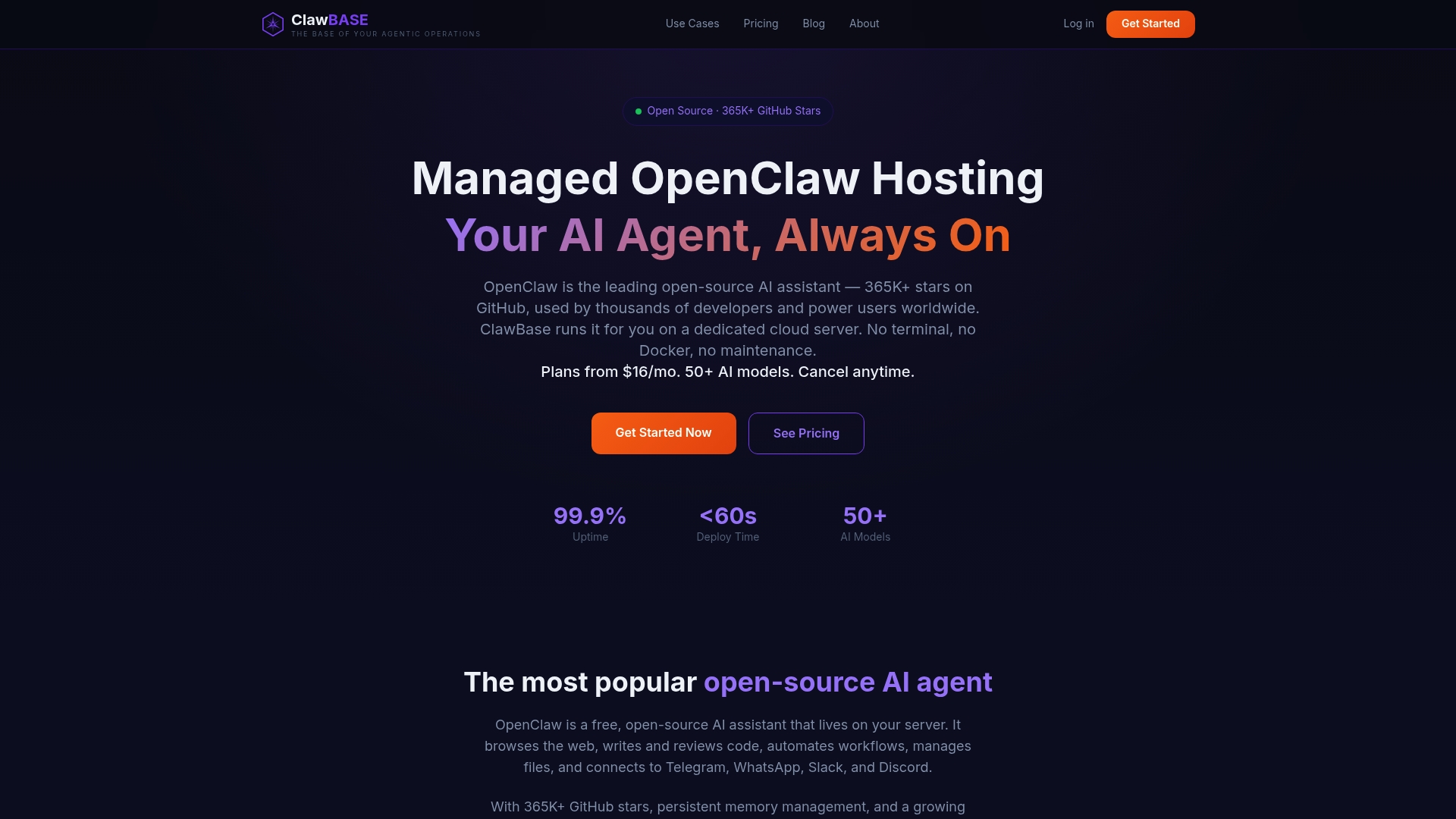
Plans on the pricing page are LITE at $16 per month or $199 per year, PRO at $33 per month or $399 per year, and MAX at $66 per month or $799 per year. You can pay by credit card or cryptocurrency.
FAQ
What is AI data residency?
It is the location where an AI system stores and processes your data, whether a country, a region or particular hardware. Storage and processing can happen in different places, and logs or support data can travel separately. Always ask about each one.
What is the difference between data residency and data sovereignty?
Residency is where data is physically held. Sovereignty is which country's laws and authorities have power over it. A provider can run a data center in one country and still be subject to another country's legal process, so the two can differ.
Is there a US law that requires AI data to stay in the US?
There is no single federal AI data-residency law. Requirements come from sector rules such as HIPAA, GLBA and FedRAMP, from state privacy laws, and from contracts. If you work in a regulated field, ask your compliance officer or attorney which apply to you.
How long do AI assistants keep my data?
It depends on the product, plan and data category. Prompts, logs, files and backups often follow different schedules, and some vendors keep abuse-monitoring logs for a set period by default. Read the provider's current retention terms and confirm how deletion treats backups.
Does a dedicated server make my AI assistant compliant?
No single setting makes anything compliant. A dedicated, encrypted server narrows where your data lives, which makes an audit easier. You still need to review the model providers you route to, your connectors and any rules specific to your industry.
Sources
- AI Literacy Foundation: Where does your data go?
- Google Cloud: Data residency for Generative AI on Vertex AI
- Google Cloud: Regionalization and data residency for Agent Assist
- Inside OpenAI's Enterprise Data Stack (Thorsten Meyer AI)
- OpenAI EU Data Residency: Moving an Existing API Setup
- IBM: Data Sovereignty vs. Data Residency
- Ropes & Gray: Whose Cloud Is It Anyway?
- AI Data Residency: US HIPAA, GLBA & FedRAMP Guide
- Chambers: Data Protection & Privacy 2026, Colorado
- OpenAI zero data retention 2026: 14 of 25 API endpoints
- How to Check an AI Vendor's Data Retention Before Buying