Long Context vs Retrieval: How to Choose for Your AI Assistant
2026-11-07

Use long context when your material is small, stable and needs whole-document reasoning. Use retrieval (RAG) when your knowledge base is large, changes often, needs citations, or has to answer cheaply at volume. Most real assistants end up combining the two: retrieve a focused set of passages, then let a long-context model reason over them.
This guide explains how each approach works, what the benchmarks show on accuracy, cost and latency, and how to decide for a personal or business assistant.
TL;DR
- Long context puts your material straight into the prompt. Retrieval searches an index first and sends only the relevant chunks.
- In an academic comparison, long context beat RAG on average, while RAG kept a large cost advantage.
- Small, stable corpora suit long context. Large, fast-changing or citation-heavy corpora suit retrieval.
- Hybrid setups (retrieve broadly, reason over a long window) are the common production answer.
- Long context did not make RAG obsolete. It changed the default first move for small jobs.
Table of Contents
- What each approach actually does
- What the benchmarks say
- Side-by-side comparison
- When long context wins
- When retrieval wins
- The hybrid answer
- How to decide: a quick checklist
- Privacy, setup and maintenance
- Perspective
- Run it on a managed OpenClaw server
- FAQ
- Sources
What each approach actually does
Both methods answer one question: how does the model get the information it needs at the moment you ask?
Long context. A context window is the maximum amount of text, measured in tokens, that a model can consider at once. It covers system instructions, your prompt, conversation history, any retrieved documents and the response being generated. With a long-context approach, you paste the documents (or load them through a file tool) and the model reads all of them on every request.
Retrieval-augmented generation. RAG has two phases. First, an indexing phase chunks your documents, converts them to vectors with an embedding model and stores them in a vector database. Second, at query time, your question is converted to a vector, matched against the database, and the best chunks are added to the prompt before the model answers. AWS frames the goal as letting a model reference an authoritative knowledge base outside its training data without retraining.

The practical difference: long context is simple to start and expensive to repeat. RAG takes setup and pays off with scale.
What the benchmarks say
The research does not crown one winner. It shows a trade-off, and the trade-off is consistent.
Accuracy
A Google DeepMind study ran RAG and long-context models on public datasets with several frontier models. It found that long context outperforms RAG on average, while RAG's much lower cost remains a distinct advantage. The same work found predictions were identical for over 60% of queries, which means retrieval gives up nothing on most requests.
Another evaluation found long context generally ahead on question-answering benchmarks, especially Wikipedia-based questions, while RAG did better on dialogue-based and general questions. The LaRA benchmark, with 2,326 test cases and eleven models, concluded that the best choice depends on model capability, context length, task type and retrieval characteristics, with no single silver bullet.
A smaller 2026 study in a manufacturing safety training setting fits the pattern. Long-context prompting reached 73.1% correctness against 65.4% for semantic RAG, though it used far more tokens per query.
Cost
Cost is where the gap is widest. In that same manufacturing study, long context cost about $0.1181 per query against roughly $0.0045 to $0.0046 for RAG, about 26 times more. Industry write-ups report the same direction. One 2026 production comparison put RAG near $0.00008 per query against roughly $0.10 for long context. Treat vendor-blog numbers as order-of-magnitude illustrations, because your model, prompt size and caching setup will move them.
The lesson is not the exact figure. It is that long context bills you for the whole corpus on every question, while retrieval bills you for a few chunks.
Latency
Latency results vary by setup. The manufacturing study, with small models and short inputs, found no statistically significant latency difference, with long-context means around 4.7 seconds against 5.1 to 5.4 seconds for RAG. At larger sizes the picture changes. A comparison using a 127,000-token prompt reported time to first token under 1.8 seconds for a RAG pipeline against 8.5 to 14.2 seconds for long context without caching, and 2.1 to 3.5 seconds with prompt caching. Caching narrows the gap a lot when the prefix stays the same.
Attention over long inputs
Bigger windows are not uniformly reliable. One 2026 analysis reports that on multi-needle retrieval benchmarks accuracy fell from roughly 92% at 256K tokens to 78% at 1M tokens, and that content buried in the middle of a long prompt can lose 30% or more accuracy compared with content near the start or end. This is the "lost in the middle" effect, and we cover how it interacts with memory in our engineering note on memory, context windows and token cost.
Side-by-side comparison
| Criterion | Long context | Retrieval (RAG) |
|---|---|---|
| Setup | Minimal: load the text | Chunking, embeddings, vector store, tuning |
| Cost per query | High, scales with corpus size | Low, scales with chunks retrieved |
| Whole-document reasoning | Strong (summaries, cross-file links) | Weaker, sees only retrieved slices |
| Corpus size | Bounded by the window | Effectively unbounded |
| Freshness | Reload the text each time | Re-index changed documents |
| Citations and attribution | Harder to isolate sources | Natural: each chunk has a source |
| Latency at scale | Grows with prompt size unless cached | Stays short |
| Main failure mode | Buried or diluted facts | Missed relevant chunks |
When long context wins
Long context is the right first move when:
- The corpus is small and stable. One 2026 cost guide suggests that for stable corpora under about 200K tokens, long context with caching is the best fit. A handbook, a contract set or a single codebase module qualifies.
- The task needs the whole picture. Summarizing a full document, comparing clauses across a contract, or finding cross-file issues in code are global tasks. In one enterprise case study on code review summarization, long context reached 89% useful ratings and 71% cross-file issue detection against 64% and 38% for RAG, at $0.082 per pull request against $0.018.
- Volume is low. If you ask a handful of questions a day, the per-query premium barely registers, and skipping an index saves engineering time.
- Completeness matters more than speed. In the 127,000-token comparison above, long context scored 96.5% completeness against 71.0% for RAG.
When retrieval wins
Retrieval is the better fit when:
- The knowledge base is huge. The same case study looked at internal Q&A over 280,000 pages. At roughly 500 tokens a page that is 140 million tokens, which does not fit in any reasonable window. RAG reached 95% Recall@8 at $0.0029 per query.
- Information changes often. Re-indexing a changed file is cheaper than reloading and re-caching a giant prompt.
- You need sources. One practitioner argues RAG is right when latency matters, when source attribution is required for compliance, when the corpus changes faster than a cache can keep up, and when cost still matters at scale.
- Many people ask many questions. The per-query savings compound quickly. Our LLM cost monitoring playbook covers how to see where tokens go.
The hybrid answer
The most useful finding is that you rarely have to choose. The DeepMind researchers proposed Self-Route, which routes each query to RAG or long context based on the model's own self-reflection, cutting computation while staying comparable to long context alone.
Two hybrid patterns show up repeatedly:
- Broad retrieval, long reasoning. One write-up notes that single-pass RAG with top-5 retrieval might miss 3 of 5 relevant documents, whereas retrieving the top 30 and passing them into a long window gives the model room to combine information across all of them.
- Cached prefix plus a small retrieval layer. A production pattern pairs a 10 to 100K-token RAG layer with a 200 to 700K-token cached prefix of always-relevant context, which keeps requests in the 2 to 5 second range.
The framing that sticks: long context solves the "not enough space" problem for small knowledge bases, and RAG solves the "too much noise" problem for large ones. Real applications need both because knowledge bases and questions are rarely uniform.
So, does long context make RAG unnecessary? No: it changed the default first move for small, fixed, low-volume jobs, but cost, freshness, recall and citations still favor retrieval for production knowledge bases.
How to decide: a quick checklist
Work through these in order.
- Estimate your corpus in tokens. Under roughly 200K and stable? Start with long context and caching. Over a million or growing? Plan for retrieval.
- Count queries per day. Multiply by the per-query cost of stuffing the full corpus. If the number hurts, retrieve.
- Check how often the data changes. Daily edits favor an index you can update incrementally.
- List the question types. "Summarize everything" leans long context. "Find the clause about X" leans retrieval.
- Decide whether you need citations. If answers must point to a source passage, retrieval gives you that structure for free.
- Pick a model that fits. Context length, price and reliability differ by model, which is why being able to swap models matters. See our guides on how models shape responses and switching models without coding.
If you route different questions to different models, the same logic applies at the model level: multi-model routing lets a cheap model handle simple lookups and a stronger one handle deep reasoning.
Privacy, setup and maintenance
Both approaches put your data in front of a model, so the security basics are the same. AWS's data security checklist for small businesses recommends multi-factor authentication for admin and high-risk accounts, least-privilege access with quarterly reviews, encryption at rest and in transit, retention rules with a defensible deletion process, and a review of vendor security terms.
Retrieval adds a few extra duties. A 2026 enterprise guide warns that essentially no vector database enforces end-user document permissions natively, that embeddings can be personal data, and that soft-deleted vectors have been recovered from raw index files. If several people share one assistant, decide up front who can see which documents. The same applies to setups where one agent serves multiple users. Maintenance matters too: Algolia's guide suggests scheduling full re-embedding monthly to account for embedding-model improvements and document updates.
Long context avoids the index but not the exposure: everything you load is sent to the model on each call, so choose where your assistant runs and who can reach it.

These choices also shape how conversational assistants behave day to day. If you are mapping the wider landscape, this overview of conversational AI systems shows how assistants are used in business workflows.
Perspective
> We spend a lot of time on the question underneath this one: what should an assistant remember, and where should that memory live?
>
> Our view is that the context window is working memory, not storage. It is fast and precise, and it is also finite and costly to refill. A useful assistant needs a layered stack: a small, always-relevant core in the prompt, persistent memory that survives between sessions, and retrieval for anything too big or too fresh to carry around. Picking one layer and ignoring the others is how teams end up with either a huge bill or an assistant that forgets.
>
> That is why we built ClawBase around a dedicated, always-on OpenClaw server with persistent memory management and access to over 50 AI models, including multi-model routing. You should not need sysadmin skills to give an agent a durable memory and a choice of models. The architecture decisions in this article are real, and you should be able to make them without also having to run the infrastructure.
>
> The best way to learn which mix suits you is to experiment with real tasks: your own documents, your own questions, your own volume. Measure cost and answer quality, then adjust the balance.
>
> *Iosif Peterfi*
Run it on a managed OpenClaw server
OpenClaw is an open-source personal AI assistant. Setting it up yourself means provisioning servers, securing them and keeping them updated. ClawBase handles that: one-click deployment on a dedicated, encrypted cloud server, 99.9% uptime, persistent memory management, daily encrypted backups, automated updates, and connections to Telegram, Discord, Slack and WhatsApp.
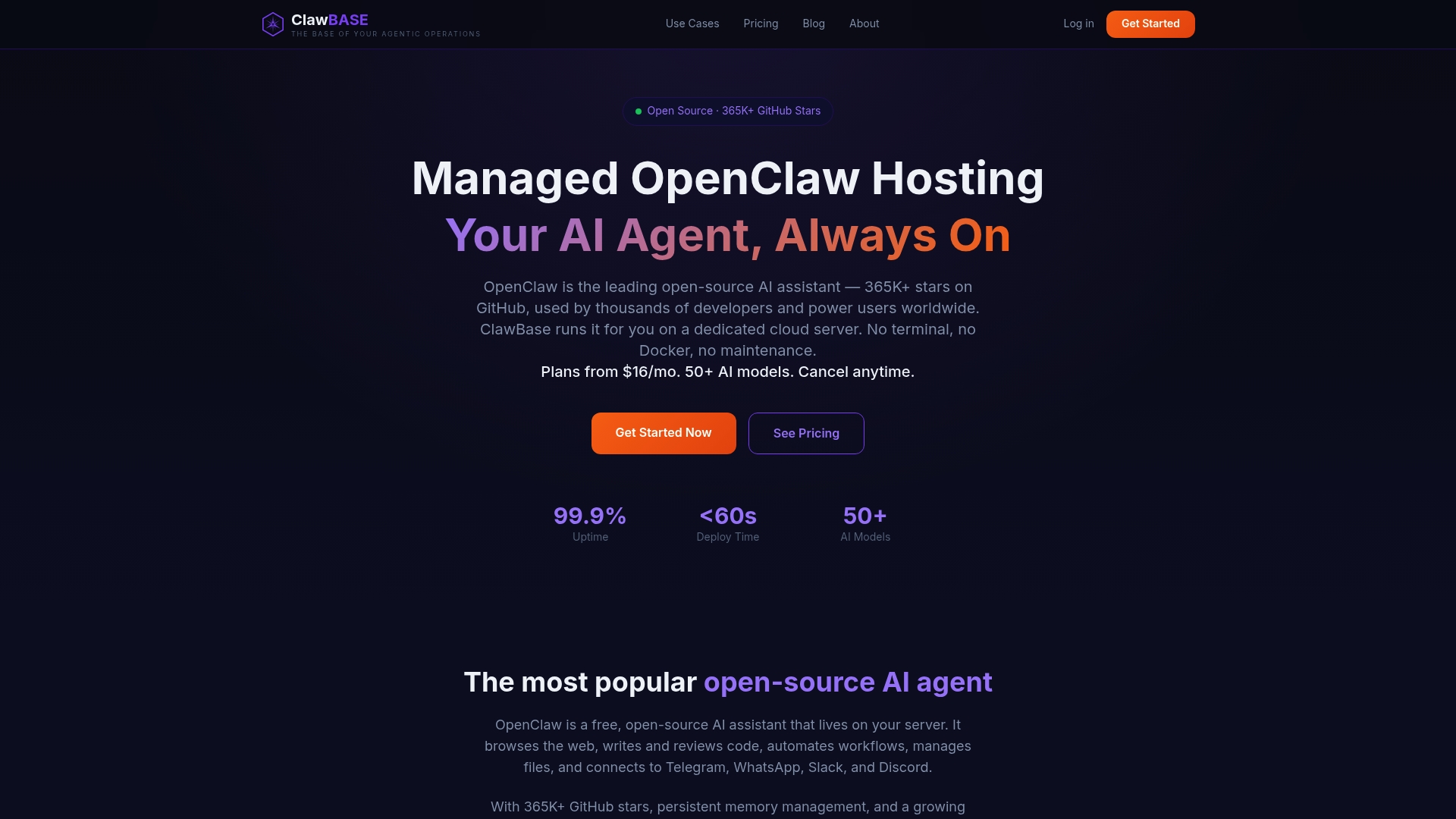
Plans start at $16 per month (LITE), with PRO at $33 per month and MAX at $66 per month. Annual billing is $199, $399 and $799 respectively. The entry plan includes a 7-day free trial. See the ClawBase plans and pricing to compare tiers.
FAQ
Is RAG dead now that models have million-token windows?
No. Large windows made loading a small, fixed document set simple, but retrieval still wins on cost, freshness, recall and citations for large knowledge bases. Production guidance in 2026 still describes hybrids that retrieve candidates and reason over them in a long window.
Is long context more accurate than RAG?
Often, on average, but not always. A DeepMind comparison found long context ahead overall, while other work found RAG better on dialogue-style questions. Accuracy also depends on where facts sit in a long prompt and on the model you use.
Which is cheaper?
Retrieval, by a wide margin at volume. One academic case study measured about 26 times the per-query token cost for long context. Prompt caching can narrow the gap when the same large prefix is reused.
Can I use both at once?
Yes. Retrieve a broad candidate set, then let a long-context model reason over it, or keep a cached core in the prompt and add a small retrieval layer on top. Query routing between the two is also an option, as described in the Self-Route work.
Do I need to build this myself to use an AI assistant?
No. A managed service runs the assistant for you, so you can focus on what it should know and do rather than on servers. Our open-source AI scalability guide explains where self-hosting gets difficult.
Sources
- Context window definition, Brave
- What Is RAG? Cognee
- What is RAG? AWS
- Retrieval Augmented Generation or Long-Context LLMs? (arXiv 2407.16833)
- Long Context vs. RAG for LLMs: An Evaluation and Revisits (arXiv 2501.01880)
- LaRA: Benchmarking Retrieval-Augmented Generation and Long-Context LLMs
- The Token Tax of Epistemic Accuracy (arXiv 2606.20898)
- RAG vs long context: what the 2026 data shows, Wire Blog
- Fine-Tuning vs RAG vs Long-Context: A Decision Framework, DevOpsNess
- Comparing Kimi K3 1M Token Context Window and RAG on Cost
- 1M Context Windows Are a Trap, KeepMyPrompts
- Long context vs RAG 2026: cost and latency guide, Ecorpit
- What 1M Context Actually Buys You, Tanay Shah
- How to Combine RAG with Long Context Windows, Adaptive Recall
- RAG vs Long Context in 2026: When to Use Which, DEV
- Essential data security checklist for SMBs, AWS
- RAG for Enterprise Knowledge Bases 2026, Frenchy Digital
- What to know when implementing RAG, Algolia
- Conversational AI Systems, Zenscape Studio