What Is an AI Deployment Pipeline? A 2026 Guide
2026-07-20

An AI deployment pipeline is defined as an automated workflow that moves a trained machine learning model from development into a live production environment in a controlled, repeatable way. The industry term for this process is "model deployment pipeline," and it sits at the heart of any serious AI deployment strategy. A well-built pipeline covers six core domains: model validation, infrastructure setup, security, monitoring, governance, and rollout strategy. Without all six, production failures are not a matter of if but when. This guide breaks down every stage, explains how deployment pipelines connect to AI data pipelines, and gives you the operational practices that separate stable production systems from costly misfires.
What is an AI deployment pipeline and why does it matter?
An AI deployment pipeline is the automated system that takes a validated model and delivers it to users reliably, at scale, and under governance controls. Think of it as the assembly line between your data science team and your end users. The pipeline handles packaging, environment configuration, security checks, traffic routing, and live monitoring without requiring manual intervention at each step.
A production checklist for a mature deployment pipeline typically spans 40 discrete points across those six domains. That number reflects real operational complexity, not bureaucratic overhead. Each point represents a failure mode that teams have encountered in production. Skipping even a handful of them introduces instability that compounds over time.
The importance of automation here cannot be overstated. Manual deployments introduce human error, slow down release cycles, and make rollback procedures inconsistent. A pipeline that automates model packaging, environment parity checks, and traffic routing gives your team a repeatable process that scales from one model to dozens.

What are the main components and stages of an AI deployment pipeline?
Production AI deployments require containerization, orchestration, API gateways, monitoring tools, and model registries to deliver reliability and security at scale. Each component plays a distinct role in the pipeline, and gaps between them are where most failures originate.
Core pipeline components
- Model registry: A centralized store like MLflow Model Registry that versions, tags, and tracks every model artifact. Without it, you cannot reliably reproduce or roll back a deployment.
- Containerization: Tools like Docker package the model with its dependencies into a portable unit. This eliminates the "it works on my machine" problem that plagues manual deployments.
- Orchestration: Kubernetes manages container scheduling, scaling, and self-healing across your infrastructure. It is the control plane that keeps your model serving layer alive under variable load.
- API gateway: Exposes model inference as a secure, rate-limited HTTP endpoint. It handles authentication, request routing, and traffic shaping between clients and model servers.
- Monitoring tools: Prometheus and similar systems collect latency, error rate, and throughput metrics in real time. They feed dashboards and alert rules that catch degradation before users notice.
- Governance layer: Enforces access policies, audit logging, and compliance controls across every stage of the pipeline.
The table below maps each component to its primary function and the failure it prevents.
| Component | Primary function | Failure it prevents |
|---|---|---|
| Model registry | Version and track model artifacts | Untracked model drift, failed rollbacks |
| Docker containers | Package model with dependencies | Environment mismatch in production |
| Kubernetes | Orchestrate and scale containers | Service downtime under load spikes |
| API gateway | Route and secure inference requests | Unauthorized access, traffic overload |
| Prometheus | Collect runtime metrics | Silent performance degradation |
| Governance layer | Enforce policies and audit trails | Compliance violations, data misuse |
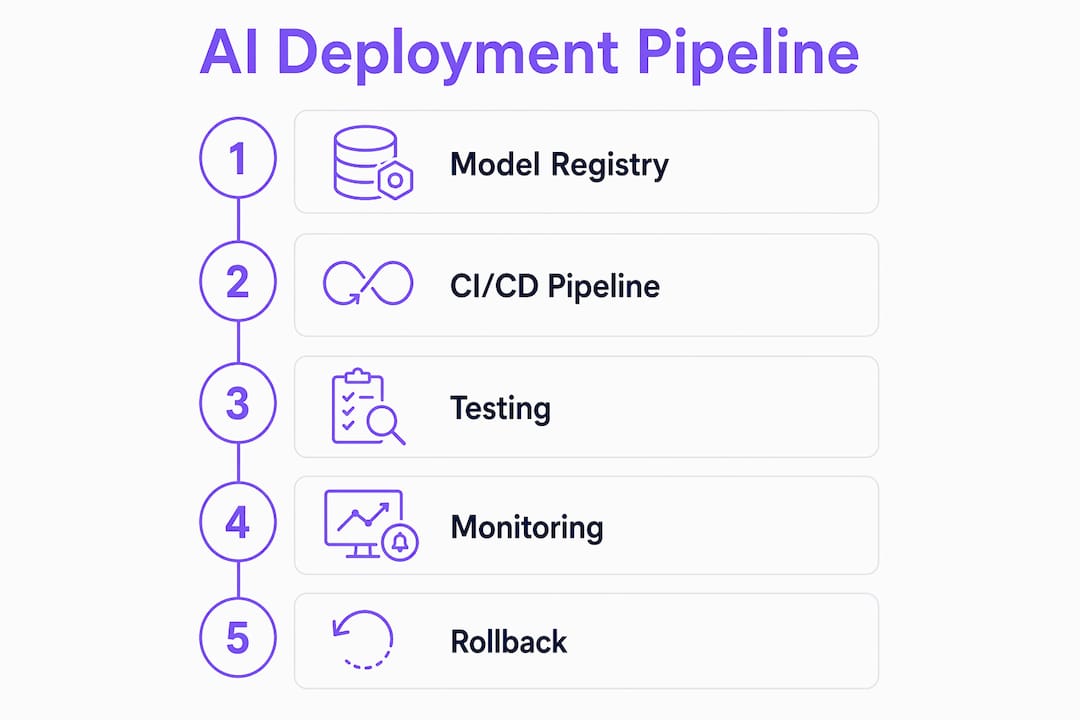
Each component depends on the others. A model registry without a CI/CD pipeline to trigger deployments is just a file store. An API gateway without a monitoring tool is a black box. The pipeline works because all components operate as a connected system.
How do AI deployment pipelines integrate with AI data pipelines?
AI pipelines differ fundamentally from traditional ETL by handling unstructured and multimodal data, enforcing strict lineage and governance to meet compliance requirements like the EU AI Act. Traditional ETL moves structured rows between databases. An AI data pipeline ingests images, audio, documents, and text streams, then transforms them into feature vectors or embeddings that a model can consume. The difference in data shape creates a difference in governance requirements.
The critical concept here is the semantic gap. A pipeline can deliver technically correct data to an AI agent while the agent still produces wrong outputs because it lacks the context to interpret that data correctly. Closing the semantic gap means delivering governance metadata alongside the data itself: lineage records, freshness timestamps, access policies, and schema definitions. Without that context layer, your model is making decisions in the dark.
Key governance requirements for AI data pipelines include:
- Data lineage tracking: Every transformation step is logged so you can trace a model output back to its source data.
- Freshness enforcement: Stale features cause model drift. The pipeline must validate that input data meets freshness thresholds before inference runs.
- Access policy propagation: Permissions defined at the data source must travel with the data through every pipeline stage.
- Anomaly detection: AI-driven transformation supervision replaces manual rule mappings, flagging unexpected data distributions before they corrupt model outputs.
Pro Tip: *Tag every dataset entering your AI pipeline with a governance manifest that includes source, lineage hash, freshness timestamp, and applicable access policies. When that manifest travels with the data through every transformation stage, you prevent the most common class of production errors: models trained on clean data failing on dirty production inputs.*
What are the best practices for AI model deployment rollouts?
Phased rollout is the standard approach for deploying AI models safely. The goal is to limit the blast radius of any failure while gathering real production signal before committing to full traffic.
A well-structured rollout follows these sequential phases:
- Shadow mode (days 1–5): Run the new model in parallel with the current production model. It receives live inputs but its outputs are not shown to users. Shadow mode requires at least 5 business days of testing to validate latency and output quality against production baselines.
- Canary release (days 6–8): Route 5% of live traffic to the new model. Define gate criteria before this phase starts: acceptable error rate, p99 latency ceiling, and business KPI thresholds. Hold for at least 48 hours before expanding.
- Staged expansion (days 9–14): Increase traffic in increments of 10–25% per stage. Each increment requires the same gate criteria to pass. Document every metric at each stage.
- Full rollout (day 15+): Shift 100% of traffic to the new model only after all staged criteria pass. Keep the previous model warm for at least 72 hours to support fast rollback.
- Post-deployment monitoring: Track model drift, infrastructure health, and business KPIs continuously. Set automated alerts for any metric that crosses a defined threshold.
Pro Tip: *Write your rollback procedure before you write your deployment script. A rollback that requires manual steps under pressure will be executed incorrectly. Automate it, test it in staging, and document the exact trigger conditions that activate it.*
Canary releases that start at 5% traffic for at least 48 hours with documented metrics and rollback triggers are the industry standard for limiting deployment risk. That 48-hour window is not arbitrary. It covers at least two full business cycles, capturing usage patterns that shorter windows miss.
What are the common challenges in AI deployment pipelines?
Most AI deployment failures trace back to missing monitoring, governance blockers, and untested infrastructure capacity under real load. These are not exotic edge cases. They are the default outcome when teams treat deployment as a one-time event rather than an ongoing operational discipline.
The most common failure points are:
- Skills mismatch: Data scientists build models. Infrastructure engineers build pipelines. When neither group owns the full deployment process, critical steps fall through the gaps. Assign a dedicated ML engineer or platform team to own the pipeline end to end.
- No centralized model registry: Without a registry, teams lose track of which model version is running in production, what data it was trained on, and how to reproduce it. Centralized model registries and standardized CI/CD pipelines are necessary to scale from a single deployment to a portfolio of models.
- Missing monitoring: A model that degrades silently is worse than one that fails loudly. Instrument every inference endpoint with latency, error rate, and output distribution metrics from day one. The role of logging in AI systems is not optional at production scale.
- Untested load capacity: Staging environments that do not mirror production traffic patterns give false confidence. Load test at 2x expected peak before any canary release.
- Dependency drift: Model containers depend on specific library versions. Without pinned dependencies and automated vulnerability scanning, a routine package update can silently break inference.
Scaling from one model to many compounds every one of these problems. A governance framework and a model registry are not nice-to-haves at scale. They are the table stakes for operating a reliable AI production environment.
How do you architect AI deployment pipelines for different environments?
Deployment environments vary across cloud-managed, on-premises, edge, and hybrid architectures, each requiring different choices around container orchestration, autoscaling, API management, and security controls. The right architecture depends on your latency requirements, data sovereignty obligations, and operational budget.
| Environment | Latency | Data sovereignty | Complexity | Cost profile |
|---|---|---|---|---|
| Cloud-managed | Low to medium | Shared responsibility | Low | Variable, usage-based |
| On-premises | Low | Full control | High | High upfront, low ongoing |
| Edge | Very low | Local only | Medium | Medium hardware cost |
| Hybrid | Variable | Configurable | High | Mixed |
Cloud-managed environments use managed Kubernetes services and auto-scaling groups to handle traffic spikes without manual intervention. They suit teams that need fast iteration and do not have strict data residency requirements. On-premises deployments give you full control over data and infrastructure but demand significant dedicated server expertise to operate reliably. Edge architectures push inference to the device or network edge, reducing latency for real-time applications like computer vision or voice processing. Hybrid architectures split workloads between cloud and on-premises based on sensitivity and latency requirements.
Regardless of environment, API management is a non-negotiable layer. Every model needs a versioned, authenticated API surface that decouples the serving layer from the consuming application. This lets you swap model versions without breaking downstream integrations.
Key Takeaways
A production-grade AI deployment pipeline requires automation, governance, phased rollout, and continuous monitoring working together as a single system.
| Point | Details |
|---|---|
| Six core domains | Every pipeline must cover model validation, infrastructure, security, monitoring, governance, and rollout strategy. |
| Governance travels with data | Attach lineage, freshness, and access metadata to every dataset entering the pipeline to prevent production errors. |
| Shadow mode before canary | Run at least 5 business days in shadow mode before routing any live traffic to a new model. |
| Centralized model registry | A registry is required to track versions, reproduce deployments, and execute reliable rollbacks at scale. |
| Architecture matches requirements | Choose cloud, on-premises, edge, or hybrid based on latency needs, data sovereignty rules, and operational capacity. |
Where teams actually struggle with AI deployment
I have worked through enough production deployments to say this plainly: the technical components are rarely the hard part. Docker, Kubernetes, Prometheus, and MLflow are well-documented and widely understood. What breaks teams is operational discipline, specifically the discipline to establish governance and monitoring frameworks before the first model goes live, not after the first incident.
The pattern I see repeatedly is this: a team ships a model quickly, skips the monitoring instrumentation because it feels like overhead, and then spends three times as long debugging a silent degradation six weeks later. The signs that you need managed AI for your team almost always include this exact scenario.
My honest recommendation is to treat your CI/CD pipeline for AI models with the same rigor you apply to application code. Automated testing, staged rollouts, and rollback procedures are not bureaucratic friction. They are the mechanism that lets you move fast without breaking production. The teams that deploy AI reliably are not the ones with the most sophisticated models. They are the ones with the most disciplined pipelines.
> *— Iosif Peterfi*
Clawbase: managed AI deployment without the infrastructure overhead
Building and maintaining a production AI pipeline from scratch demands significant infrastructure expertise. Clawbase removes that barrier by providing managed OpenClaw hosting from $16/month, giving your team a private, always-on AI agent without the sysadmin burden.
Clawbase handles server provisioning, security configuration, uptime monitoring, and compliance frameworks so your team focuses on building, not maintaining. With 99.9% uptime, persistent memory management, and access to over 50 AI models, it is a production-grade platform that fits teams at any scale. If you want to see what a fully managed AI agent can do in your workflows, the Clawbase use cases page covers the full range of capabilities available today.
FAQ
What is an AI deployment pipeline in simple terms?
An AI deployment pipeline is an automated workflow that moves a trained model from development into production, handling packaging, environment setup, security, and monitoring without manual steps at each stage.
How does an AI deployment pipeline differ from an AI data pipeline?
An AI data pipeline ingests and transforms raw data into model-ready features. An AI deployment pipeline takes the trained model and delivers it to users. Both must share governance metadata to prevent production failures.
What is shadow mode in AI model deployment?
Shadow mode runs a new model on live production inputs without exposing its outputs to users. Industry standard practice requires at least 5 business days in shadow mode before any canary traffic is routed to the new model.
What causes most AI deployment failures?
Missing monitoring, governance gaps, and untested infrastructure capacity are the top causes of production AI deployment failures. These are preventable with a structured pipeline and pre-deployment load testing.
Do I need a model registry for AI deployment?
A centralized model registry is required for any team managing more than one model in production. It tracks versions, stores artifacts, and enables reliable rollbacks when a deployment needs to be reversed quickly.